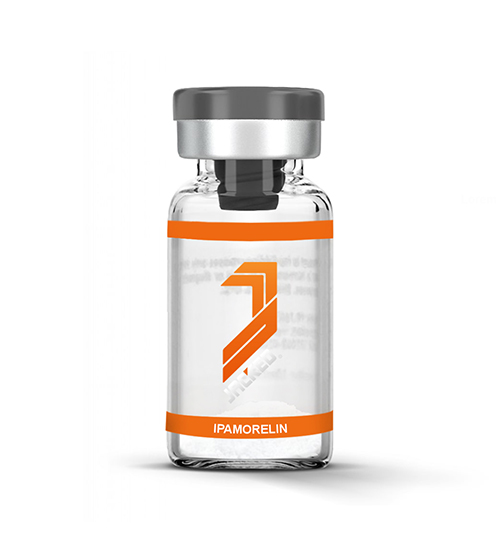
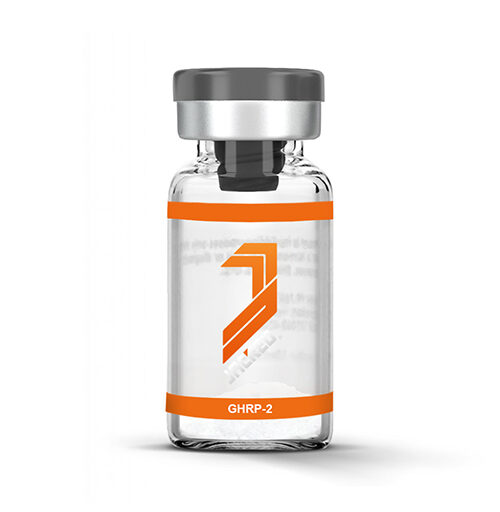
Ipamorelin 5 mg – Selective GH Secretagogue for Scientific Research
⚠️ Legal Notice: Ipamorelin is intended exclusively for scientific and research purposes. It is not intended for human use as a medication, dietary supplement, or cosmetic product. Sale restricted to individuals over the age of 18.
What is Ipamorelin?
Ipamorelin is a synthetic pentapeptide —a compound consisting of five amino acids with the amino acid sequence Aib-His-D-2Nal-D-Phe-Lys-NH₂. It was derived from research on GHRP-1 and belongs to the group of growth hormone secretagogues (GHS—Growth Hormone Secretagogues).
Ipamorelin is characterized by exceptional selectivity within the group of growth hormone secretagogues. While related compounds such as GHRP-2 or GHRP-6 increase not only GH levels but also cortisol and prolactin at research dosages, Ipamorelin does not exhibit these hormonal side effects in preclinical studies. It is precisely this selectivity that makes Ipamorelin one of the most extensively studied GH peptides in the field of endocrinology.
Important: Ipamorelin is not approved as a drug in the European Union or in other jurisdictions. All available data come from preclinical studies (in vitro and in vivo in animal models).
Mechanism of Action in Research
Selective activation of GHS-R1a—without cortisol or prolactin
Ipamorelin acts as a selective agonist of the ghrelin receptor GHS-R1a in the anterior pituitary and hypothalamus. By activating this receptor, it stimulates the pulsatile release of growth hormone from somatotrophic cells in the anterior pituitary.
A key research characteristic of Ipamorelin lies in its selectivity: preclinical studies and controlled clinical research protocols consistently demonstrate that, at typically tested doses, Ipamorelin does not increase levels of cortisol (adrenal cortex glucocorticoids) or prolactin (a pituitary hormone). This property stands in direct contrast to GHRP-2 and GHRP-6, both of which increase these hormones.
Selective action on GHS-R1a without activating the pathways responsible for cortisol/prolactin release allows researchers to study GH secretion in isolation, free from the confounding effects of the HPA axis (hypothalamic-pituitary-adrenal).
Source: Raun K. et al., European Journal of Endocrinology (1998); Bowers CY., Endocrine (1998)
Comparison of Selectivity: Ipamorelin vs. GHRP-2 vs. GHRP-6
| Property | Ipamorelin | GHRP-2 | GHRP-6 |
| Peptide Type | Pentapeptide | Hexapeptide | Hexapeptide |
| Receptor | GHS-R1a | GHS-R1a | GHS-R1a |
| GH Release Intensity | Moderate–strong | Strong | Strong |
| Effect on Cortisol | None/minimal | Increase | Increase |
| Effect on prolactin | None/minimal | Increase | Increase |
| Effect on Appetite | Minimal | Mild | Significant |
| Selectivity for GH | High | Low | Low |
Note: This table summarizes the results of preclinical research and is not intended to provide clinical recommendations.
The Synergistic Combination of Ipamorelin and CJC-1295 in Research
One of the most extensively studied combinations in the field of GH peptides is the combination of Ipamorelin (a GHS-R1a agonist) with CJC-1295 or Modified GRF 1-29 (a GHRH analog). These two classes of compounds act through different receptors and independent signaling pathways.
GHRH analogs (CJC-1295, Modified GRF 1-29) activate the GHRH-R receptor on somatotrophs, thereby increasing their sensitivity to further stimuli. Ipamorelin simultaneously activates GHS-R1a. According to preclinical studies in animal models, this results in an amplified GH pulse —a more pronounced increase in GH secretion compared to the administration of each compound alone.
This synergistic interaction is of scientific interest because it reflects the natural mechanism by which GH secretion is regulated in vivo: the hypothalamus releases both GHRH and ghrelin (an endogenous ligand for GHS-R1a) simultaneously, and their combined effect is stronger than the sum of their individual effects.
Source: Khorram O. et al., Journal of Clinical Endocrinology & Metabolism (1997); Chapman IM. et al., Journal of Clinical Endocrinology & Metabolism (1997)
Areas of Scientific Research on Ipamorelin
Research on Muscle Mass and Lipolysis
Preclinical studies in rat models show that chronic administration of Ipamorelin is associated with an increase in muscle mass and a decrease in adipose tissue. These changes are attributed to increased GH secretion and the subsequent stimulation of IGF-1 production in the liver. IGF-1 is a key mediator of GH’s anabolic and lipolytic effects.
Ipamorelin’s selective profile (without cortisol or prolactin surges) makes the interpretation of research results regarding muscle mass less complicated compared to less selective GH secretagogues.
Gastrointestinal Research – Motility and Postoperative Ileus
A lesser-known but scientifically interesting property of Ipamorelin is its effect on gastrointestinal motility. GHS-R1a receptors are expressed not only in the pituitary gland but also in the gastrointestinal tract, where they play a role in regulating intestinal motility.
Preclinical studies in models of postoperative ileus (temporary cessation of peristalsis following surgery) demonstrate that ipamorelin accelerates the recovery of gastrointestinal motility compared to control groups. These results are the subject of further scientific investigation in the context of postoperative care.
Source: Poitras P. et al., Peptides (2005)
Technical Specifications
| Parameter | Value |
| Chemical Name | Ipamorelin |
| Type | Synthetic pentapeptide |
| Amino acid sequence | Aib-His-D-2Nal-D-Phe-Lys-NH₂ |
| Origin | Derived from GHRP-1 |
| Molecular weight | 711.9 Da |
| CAS Number | 170851-70-4 |
| Form | Lyophilized (freeze-dried) white powder |
| Contents per package | 5 mg |
| Purity | ≥ 98% (HPLC-verified) |
| Recommended storage conditions | −20 °C, protected from light and moisture |
| Stability (lyophilisate) | Up to 24 months at −20 °C |
| Stability (reconstituted) | Up to 28 days at 4 °C, up to 6 months at −20 °C |
| Intended Use | For scientific research purposes only |
Frequently Asked Questions About Ipamorelin
⚠️ Warning – Intended exclusively for research purposes
All products sold on jacked.sk are intended EXCLUSIVELY for scientific research purposes. They are not intended for use as a medicine, drug, dietary supplement, or cosmetic product, nor for human or veterinary use. The results cited in the descriptions are based on preclinical studies (in vitro, animal models) and cannot be automatically extrapolated to human use. Sale restricted to individuals over the age of 18. By purchasing this product, the customer confirms that they are a professional researcher and will use the product solely in accordance with applicable laws.