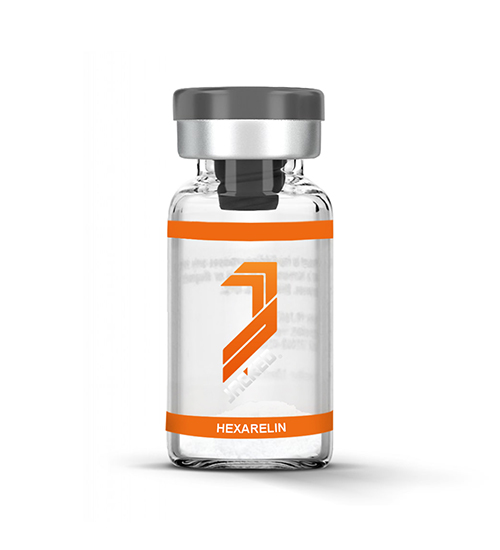
Hexarelin 5 mg – The Most Potent GHRP Secretagogue for GH Research and Cardioprotection
⚠️ Warning: This product is intended solely for scientific research purposes (research use only). It is not intended for use as a medicine, drug, dietary supplement, or for human use. Sale restricted to individuals over the age of 18.
What is Hexarelin?
Hexarelin is a synthetic hexapeptide (6 amino acids) belonging to the class of GH secretagogues (GHRP – Growth Hormone-Releasing Peptides). Within this class of compounds, hexarelin is considered one of the most potent GH secretagogues based on the results of preclinical and clinical pharmacokinetic studies.
Chemically, it is a modified hexapeptide with the following sequence: His-D-2-MeTrp-Ala-Trp-D-Phe-Lys-NH₂, which contains D-amino acids that increase its metabolic stability against enzymatic degradation.
Synthetic hexapeptide: structure and classification within the GHRP class
GHRP (Growth Hormone-Releasing Peptides) are a group of synthetic peptides that stimulate the release of GH by acting on the ghrelin receptor (GHS-R1a). In addition to Hexarelin, this class includes GHRP-2, GHRP-6, and Ipamorelin, each of which exhibits a distinct pharmacological profile and potency.
Mechanism of action: GHS-R1a and GH secretion
The primary mechanism of action of Hexarelin is its agonism at the GHS-R1a (Growth Hormone Secretagogue Receptor 1a) —a receptor that is identical to the ghrelin receptor. Activation of this receptor on somatotrophic cells of the pituitary gland leads to the release of endogenous growth hormone (GH).
The mechanism involves activation of the phosphoinositide signaling pathway (PKC), which leads to an increase in intracellular Ca²⁺ and subsequent exocytosis of secretory granules containing GH.
Potency Compared to Other GHRP’s
Based on preclinical studies, Hexarelin exhibits significantly higher GH-stimulating activity compared to other members of the GHRP class:
| GHRP compound | Relative Potency (GH Secretion) | Effect on cortisol/prolactin |
| Hexarelin | ★★★★★ (highest) | Yes – increased cortisol and prolactin |
| GHRP-2 | ★★★★☆ | Mild effect |
| GHRP-6 | ★★★☆☆ | Mild effect, strong effect on ghrelin |
| Ipamorelin | ★★★☆☆ | High selectivity – minimal impact |
Note: The table is based on preclinical pharmacokinetic data. The relative potency is approximate.
Unique Feature: Cardioprotective research independent of GH
The most significant and scientifically innovative aspect of Hexarelin is its cardioprotective mechanism, which has been documented in preclinical studies as being independent of GH secretion.
Binding to the CD36 receptor in cardiomyocytes
In addition to GHS-R1a, hexarelin binds to CD36 —a scavenger receptor expressed on the surface of cardiomyocytes, macrophages, and other cells—and to a truncated form of the GHS-R receptor present in cardiac tissue. This binding mediates direct cardioprotective effects independent of pituitary GH secretion.
Preclinical Studies: Ischemia, Reperfusion, and Apoptosis of Cardiomyocytes
In preclinical studies using isolated hearts (Langendorff model) and animal models, Hexarelin was investigated in the context of:
- Ischemia/reperfusion – research on the preservation of cardiac function following a reduction in blood supply
- Cardiomyocyte apoptosis —studies suggest a reduction in heart muscle cell death under ischemic conditions
- Contractile Function —Measurement of Cardiac Output and Ejection Fraction in Experimental Models
These cardioprotective effects represent a unique aspect of Hexareelin research that distinguishes it from other GHRP compounds. Results from preclinical studies suggest that the mechanism involves CD36-mediated signaling independent of circulating GH or IGF-1.
All of the above results are from preclinical studies (in vitro, isolated organs, animal models) and cannot be extrapolated to human use.
Research Note: Desensitization with Chronic Administration
Preclinical studies with hexarelin document the phenomenon of GHS-R1a receptor desensitization following repeated or chronic administration. This phenomenon—typical of receptor agonists—manifests as a gradual decrease in the amplitude of the GH response upon long-term exposure.
From a research perspective, this property is important when designing experimental protocols. Desensitization has been documented to varying degrees with other GHRP compounds as well, with hexarelin exhibiting this phenomenon to a greater extent than ipamorelin or GHRP-2.
Technical Specifications and Storage
| Parameter | Value |
| Form | Freeze-dried powder |
| Quantity | 5 mg per bottle |
| Purity | ≥98% (HPLC verified) |
| CAS Number | 140703-51-1 |
| Molecular weight | 887.0 Da |
| Sequence | His-D-2-MeTrp-Ala-Trp-D-Phe-Lys-NH₂ |
| Type | GHRP / GH secretagogue |
| Receptor | GHS-R1a (primary), CD36 (secondary) |
| Storage (long-term) | -20 °C (lyophilized) |
| Storage (after reconstruction) | 2–8 °C, use within 28 days |
| Reconstitution | Bacteriostatic water or sterile water |
Frequently Asked Questions About Hexarelin
⚠️ Warning – Intended exclusively for research purposes
All products sold on jacked.sk are intended EXCLUSIVELY for scientific research purposes. They are not intended for use as a medicine, drug, dietary supplement, or cosmetic product, nor for human or veterinary use. The results cited in the descriptions are based on preclinical studies (in vitro, animal models) and cannot be automatically extrapolated to human use. Sale restricted to individuals over the age of 18. By purchasing this product, the customer confirms that they are a professional researcher and will use the product solely in accordance with applicable laws.