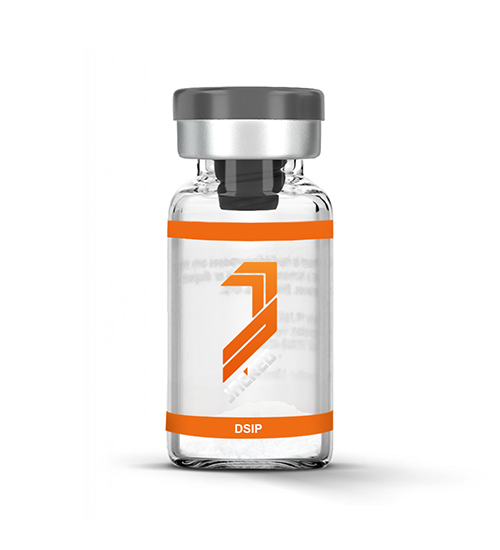
DSIP 10 mg – Delta Sleep-Inducing Peptide for Sleep Cycle Research
⚠️ Legal Notice: DSIP is intended exclusively for scientific and research purposes. It is not intended for human use as a medication, dietary supplement, or cosmetic product. Sale is restricted to individuals over the age of 18.
What is DSIP?
DSIP (Delta Sleep-Inducing Peptide) is a nonapeptide composed of 9 amino acids with the sequence Trp-Ala-Gly-Gly-Asp-Ala-Ser-Gly-Glu. It is an endogenous peptide with a molecular weight of 848.8 Da that has been identified in brain tissue and cerebrospinal fluid. DSIP is one of a group of neurobiologically active peptides with a potential role in regulating sleep states and neuroendocrine processes.
Unlike many synthetic research peptides, DSIP is of endogenous origin—it was isolated directly from mammalian biological material. This fact makes it an interesting subject of research in terms of the natural regulatory mechanisms of sleep.
Important: DSIP is not approved as a drug or dietary supplement in the European Union or elsewhere. All biological data are derived from in vitro and in vivo studies in animal models, or from preliminary human studies conducted in the 1970s and 1980s.
History of the Discovery and Scientific Origins
DSIP was discovered in 1974 by Prof. Marcello Monnier and colleagues at the University of Basel (Switzerland). Monnier and his team monitored electrical changes in the brains of cats following electrical stimulation of the thalamus and found that brain dialysate from the stimulated animals could induce delta sleep in other (unstimulated) individuals following intravenous administration.
This groundbreaking study suggested the existence of an endogenous molecule responsible for initiating deep (delta) sleep. The subsequent isolation and characterization of this molecule led to the identification of a nonapeptide, which was named Delta Sleep-Inducing Peptide (DSIP).
In the 1980s, the DSIP was the subject of intense scientific interest, with research being conducted at several European and American institutions. Interest in DSIP is experiencing a resurgence in the context of modern research in neuroendocrinology and chronobiology.
Source: Monnier M. et al., Pflügers Archiv (1977); Schoenenberger GA. et al., European Neurology (1978)
Mechanism of Action in Research
Modulation of Delta Wave Activity (EEG)
The key research hypothesis centers on the ability of DSIP to modulate delta wave activity in the brain, as measured by electroencephalography (EEG). Delta waves (0.5–4 Hz) are characteristic of the deepest stage of non-REM sleep (N3), which is considered biologically essential for physical recovery, memory consolidation, and neuroendocrine regulation.
Preclinical studies in animal models have documented an increase in the proportion of delta-wave sleep following DSIP administration. Interpreting these results in the context of human neuroscience requires further research.
Interaction with the hypothalamic-pituitary-adrenal (HPA) axis
Research suggests that DSIP may interact with the hypothalamic-pituitary-adrenal (HPA) axis —the primary neuroendocrine regulator of the stress response. The HPA axis regulates cortisol production via the CRH → ACTH → cortisol cascade. Some studies document the effect of DSIP on the rhythmic secretion of corticotropin and melatonin, placing it within the field of research on circadian rhythms and stress adaptation.
Antinociceptive and Antioxidant Properties
In addition to sleep research, in vitro studies and animal models have shown potential antinociceptive properties of DSIP (reduction in pain perception), as well as preliminary results suggesting antioxidant activity. These areas are in the basic research stage and require confirmation in further studies.
Sources: Kastin AJ. et al., Pharmacology, Biochemistry, and Behavior (1981); Khvatova EM. et al., Peptides (2003)
DSIP Research Areas
Research on Sleep Cycles and Delta Activity
DSIP’s primary area of research remains the modulation of sleep architecture, specifically the proportion and quality of delta (deep non-REM) sleep. Research protocols include polysomnography in animal models and correlational studies using EEG measurements. This area is relevant to research groups focusing on the neurobiology of sleep, chronobiology, and sleep disorder research.
Regulation of the Stress Response and Cortisol
The interaction of DSIP with the HPA axis makes this peptide of interest for research into stress physiology. Studies are investigating its potential effects on basal and stress-induced cortisol secretion, as well as on the body’s adaptation to repeated stressors. This research is relevant to the fields of neuropsychology and behavioral neuroscience.
Preliminary research into other properties
The literature documents further research interest in DSIP in the following contexts:
– Modulation of the opiate system (interaction with opioid receptors in preclinical models)
– Effects on body temperature and thermoregulation
– Preliminary research in models of epileptic activity
All of these areas are in the basic research stage, with insufficient data to support any generalizations.
Limitations and Technical Notes
It is important for research teams working with DSIP to understand its pharmacokinetic properties:
- Low oral bioavailability: DSIP undergoes hydrolysis by intestinal peptidases, which significantly limits its bioavailability following oral administration. Research protocols therefore typically employ parenteral administration (intravenous, subcutaneous, or intracerebral administration in animal models).
- Short Biological Half-Life: Like most small peptides, DSIP has a relatively short half-life in circulation due to enzymatic degradation by peptidases.
- Reproducibility of results: Some early studies on DSIP have been criticized for methodological flaws. Modern research requires strictly controlled conditions and reproducible protocols.
Technical Specifications
|
Parameter |
Value |
|
Chemical Name |
DSIP (Delta Sleep-Inducing Peptide) |
|
Amino acid sequence |
Trp-Ala-Gly-Gly-Asp-Ala-Ser-Gly-Glu |
|
Number of amino acids |
9 (nonapeptide) |
|
Molecular weight |
848.8 Da |
|
CAS Number |
62697-97-6 |
|
Form |
Freeze-dried white powder |
|
Package Contents |
10 mg |
|
Purity |
≥ 98% (verified by HPLC) |
|
Recommended Storage Conditions |
−20 °C, protected from light and moisture |
|
Purpose |
Exclusively for scientific research purposes |
Frequently Asked Questions About DSIP (FAQ)
DSIP (Delta Sleep-Inducing Peptide) is an endogenous nonapeptide (9 amino acids) discovered in 1974 by Prof. Marcello Monnier and his team at the University of Basel. It was isolated from the brain dialysate of cats following electrical stimulation of the thalamus that induced delta sleep.
DSIP was named for its ability to modulate delta wave activity in the brain (deep non-REM sleep), as observed in preclinical studies. Research is exploring its potential role in regulating sleep architecture, the HPA axis, and circadian rhythms. It is neither a drug nor a dietary supplement.
DSIP has low oral bioavailability—it is rapidly hydrolyzed by intestinal peptidases. Therefore, scientific research typically uses parenteral (intravenous or subcutaneous) protocols in animal models.
DSIP from jacked.sk has a purity of ≥98%, verified by HPLC. A Certificate of Analysis (COA) is available upon request.
Store unopened packages at −20 °C, protected from light and moisture. Avoid repeated thawing and freezing.
DSIP is not included on the list of controlled substances in the EU or in Slovakia. Sold exclusively for scientific research purposes to individuals over the age of 18. The purchaser is responsible for ensuring that the product is used in accordance with applicable laws.