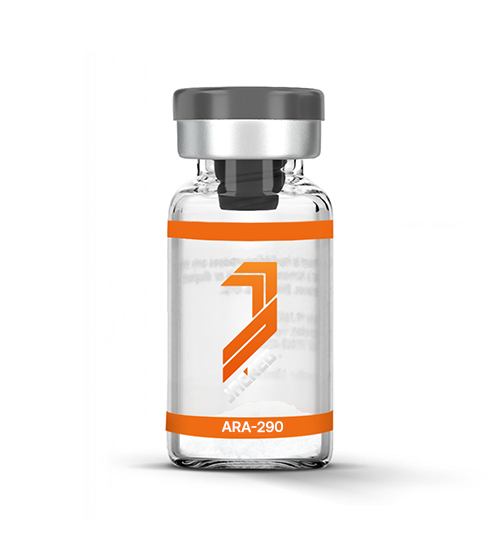
ARA-290 10 mg – Erythropoietin Derivative for Research into Neuroprotection and Regeneration
⚠️ Legal Notice: ARA-290 is intended exclusively for scientific and research purposes. It is not intended for human use as a medication, dietary supplement, or cosmetic product. Sale exclusively to individuals over the age of 18.
What is ARA-290 (cibinetide)?
ARA-290, also known as cibinetide, is a cyclic peptide composed of 11 amino acids derived from a structural region of erythropoietin (EPO). It was developed and patented by Araim Pharmaceuticals (USA) with the aim of isolating the tissue-protective properties of EPO from its undesirable hematopoietic effects.
Erythropoietin is an endogenous glycoprotein hormone primarily responsible for regulating red blood cell production (erythropoiesis). However, research has revealed that EPO also acts through another receptor system— the INNATE REPAIR RECEPTOR (IRR) —thereby mediating tissue-protective and anti-inflammatory effects independent of erythropoiesis.
ARA-290 was designed to selectively activate IRR without binding to the classical erythropoietin receptor (EPOR), thereby avoiding thrombotic and other risks associated with its hematopoietic effect. This selectivity makes ARA-290 an attractive subject for research in longer-term non-hematological studies.
Important: ARA-290 is not approved as a drug in the European Union or the United States. The available data are derived from preclinical studies and Phase 1–2 clinical trials.
Key feature: tissue protection without erythropoietin activity
The most significant research aspect of ARA-290 is its ability to activate EPO’s tissue-protective signaling pathways without stimulating erythropoiesis. This distinction is crucial for several reasons:
- Long-term administration of erythropoietin increases hematocrit (the percentage of red blood cells in the blood), which increases blood viscosity and the risk of thromboembolic complications.
- ARA-290 does not present these risks —no stimulation of erythropoiesis or changes in hematocrit were observed in preclinical and Phase 1–2 clinical studies.
- This feature makes it possible to study longer-term research protocols without hematological concerns, which is valuable from a scientific standpoint.
Research has identified IRR (Innate Repair Receptor) as a heterodimer consisting of EPOR and the beta-common chain (βc, also known as CD131). This receptor is expressed primarily in non-neural and neural tissues (not in erythroid progenitors), which explains the tissue selectivity of ARA-290.
Mechanism of Action – INNATE REPAIR RECEPTOR (IRR)
Activation of a tissue-protective cytokine receptor
ARA-290 binds to and activates the INNATE REPAIR RECEPTOR (IRR), also known as TPCR (Tissue Protective Cytokine Receptor). This receptor is a heterodimer composed of: – Erythropoietin receptor (EPOR) – one subunit – Beta-common chain (βc, CD131) – the second subunit, shared with receptors for IL-3, IL-5, and GM-CSF
Activation of IRR triggers intracellular signaling cascades involving the PI3K/Akt and JAK2/STAT5 pathways, which are associated with anti-apoptotic and anti-inflammatory effects in various tissues.
Department of Tissue-Protective and Hematopoietic Effects of EPO
Conventional erythropoietin acts through homodimeric EPOR (two EPOR subunits), leading to hematopoietic activation. ARA-290 was structurally designed to interact preferentially with IRR (the EPOR–βc heterodimer), rather than with homodimeric EPOR. This selective targeting is the basis for its distinct pharmacological profile.
Sources: Brines M. et al., PNAS (2008); van der Linden D. et al., PLoS ONE (2015); Niesters M. et al., Anesthesiology (2014)
ARA-290 Research Areas
Neuroprotection and dorsal root ganglia (DRG)
One of the key areas of research for ARA-290 is neuroprotection at the level of the dorsal root ganglia (DRG) —clusters of nerve cells (sensory neurons) located along the spinal cord. The DRGs are responsible for transmitting sensory signals, including pain. Preclinical studies have demonstrated the protective effect of ARA-290 on these neurons in models of peripheral neuropathy.
Research on Neuropathic Pain
Based on preclinical research, Araim Pharmaceuticals has initiated Phase 2 clinical trials focused on neuropathic pain associated with small fiber neuropathy (SFN) —a form of peripheral neuropathy affecting small unmyelinated nerve fibers. Results from pilot clinical trials showed a reduction in neuropathic pain symptoms and an improvement in nerve fiber density (skin biopsy IENF density) compared to placebo.
These results are preliminary and come from small studies. Their clinical relevance requires confirmation in larger randomized controlled trials.
Inflammatory Processes and Tissue Repair
ARA-290 is also being studied in the areas of inflammatory processes and tissue repair. Preclinical models demonstrate its anti-inflammatory effects through modulation of the cytokine response and a reduction in inflammatory cell infiltration. In a model of diabetic nephropathy, a protective effect on renal tissue was observed.
Clinical Research Context
Araim Pharmaceuticals has conducted several Phase 1 and 2 clinical trials with ARA-290 (cibinetide):
- Phase 1: Demonstration of safety and tolerability in healthy volunteers. Confirmation of the absence of hematopoietic activity.
- Phase 2 – Small Fiber Neuropathy (SFN): A pilot study documented a statistically significant reduction in neuropathic pain symptoms and an improvement in intraepidermal nerve fiber density (IENFD).
- Phase 2 – Sarcoidosis with Neuropathy: The ARA-290 Study in Patients with Sarcoidosis Complicated by Small-Fiber Neuropathy.
Important Notice: ARA-290 is not approved as a drug in the EU or the U.S. Clinical studies have not demonstrated sufficient efficacy to support regulatory approval for any indication. The product sold on jacked.sk is a research compound, not a drug.
Comparison of ARA-290 vs. Erythropoietin (EPO)
| Property | Erythropoietin (EPO) | ARA-290 (cibinetide) |
| Receptor | Homodimeric EPOR (hematopoietic) | IRR / TPCR (EPOR–βc heterodimer) |
| Erythropoietic activity | YES – stimulation of erythrocyte production | NO – no hematopoietic activity |
| Tissue-protective activity | Partial (via IRR) | Primary function |
| Risk of Thrombosis | Increased with long-term use | Not reported in Phase 1–2 studies |
| Clinical Use | Anemia associated with CKD, chemotherapy, and HIV | In the research stage (Phase 2) |
| Usage on jacked.sk | N/A (not in the catalog) | For scientific research purposes only |
Technical Specifications
| Parameter | Value |
| Chemical name | ARA-290 (cibinetide) |
| Origin | A cyclic peptide derived from erythropoietin (EPO) |
| Sequence length | 11 amino acids (cyclic structure) |
| Molecular weight | ~1,200 Da |
| CAS Number | 1208243-50-8 |
| Form | Lyophilized (freeze-dried) white powder |
| Contents per package | 10 mg |
| Purity | ≥ 98% (HPLC-verified) |
| Recommended storage conditions | −20 °C, protected from light and moisture |
| Intended Use | For scientific research purposes only |
Frequently Asked Questions About ARA-290
⚠️ Warning – Intended exclusively for research purposes
All products sold on jacked.sk are intended EXCLUSIVELY for scientific research purposes. They are not intended for use as a medicine, drug, dietary supplement, or cosmetic product, nor for human or veterinary use. The results cited in the descriptions are based on preclinical studies (in vitro, animal models) and cannot be automatically extrapolated to human use. Sale restricted to individuals over the age of 18. By purchasing this product, the customer confirms that they are a professional researcher and will use the product solely in accordance with applicable laws.